
When you find out you have keratoconus, it can feel like your normal vision is over. Patients are afraid of surgery, progressive blur, and distorted vision. But today, thousands of people are getting a second chance with scleral lenses, which don’t require a corneal transplant.
In this blog, we tell the true stories of patients in 2025 who beat advanced keratoconus, lens intolerance, and even problems after surgery, all thanks to custom-made scleral lenses.
These stories show how important it is to design lenses with precision, teach patients, and provide regular follow-up care. If you have keratoconus, these journeys may help you see things more clearly and give you hope.
Case 1: A 19-Year-Old Engineering Student Avoids Transplant Challenge:
This student had advanced keratoconus, which made their vision very blurry and distorted. The glasses didn’t help. Another hospital had suggested a corneal transplant.
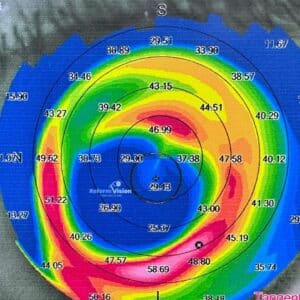
After a thorough imaging workup, Reform Vision prescribed topography-guided scleral lenses as a solution. His vision got better from 6/60 to 6/9 in just two weeks.
He went back to taking classes online, drove safely, and didn’t need surgery. His corneas are stable now, and he wears his lenses every day.
Case 2: An IT professional in their 40s who has post-LASIK ectasia
This patient got post-LASIK ectasia, a type of keratoconus, 12 years after LASIK. His growing light and blur sensitivity made it hard for him to do his job.
Solution: We chose a mini-scleral lens design that would go over the uneven flap area while still letting oxygen flow. The lens fit was based on tear film mapping.
Outcome: His headaches went away and his vision came back to 6/6. He can now work on screens for more than 10 hours a day without any problems.
Case 3: A woman in her 40s had INTACS put in 5 years ago.
She was a homemaker and had very dry eyes. Her vision was still blurry, and her eyes were very dry and red.
Solution: We took pictures of the INTACS zone using anterior segment OCT. A large-diameter scleral lens was put on to protect the surface of the eye and fix problems with the cornea.
After one month, vision went from 6/36 to 6/12. More importantly, her redness, burning, and tearing went away, which made her life much better.
Case 4: A young adult who is anxious about their vision and doesn’t have a lot of confidence
A 22-year-old with advanced keratoconus who was shy wore thick glasses and didn’t look people in the eye. It hurt his self-esteem.
Solution: Scleral lenses were given with a gentle education plan and regular checkups. We also looked at binocular vision.
Outcome: He started wearing glasses all the time. He got his vision back to 6/6 and started getting ready for job interviews. His parents saw that he was more confident and social.
Case 5: A School Teacher Who Had a Corneal Graft Struggles With Blurry Vision After the
Procedure: A schoolteacher still had blurry, unstable vision after having a corneal transplant in one eye. Soft lenses and glasses didn’t work.
Solution: High-resolution OCT scans were used to make a custom reverse geometry scleral lens. The vault was changed to fit the graft profile.
Result: There was no corneal touch, and visual acuity was 6/9. She went back to teaching without feeling anxious or tired.
Why These Stories Are Important
Not only did these patients get better vision, but they also got their lives back. Their stories show that:
Scleral lenses work even for advanced, post-surgical, or dry eyes. Personalized imaging and expert fitting can change your life. In most cases of keratoconus, non-surgical care is not only possible, but also better.
Quotes from Patients That Motivate
“I thought surgery was my only chance. These lenses have helped me see clearly and live fully today. — Rakesh, 21
“Every doctor told me to stop wearing lenses.” I finally got a pair that worked at Reform Vision. — Lakshmi, 42
“I used to be afraid of the sun and car lights.” I like my evening walks again. — Anita, 39
Last Thoughts
Keratoconus isn’t the end of the line. You can get clear, stable, and comfortable vision back without surgery if you get your scleral lenses fitted by a professional and have modern imaging done. Every day at Reform Vision, we see lives change, and we’re here to help you write your own success story.
About the Writer
Reform Vision Hyderabad’s Reekham Lal is an expert in specialty contact lenses. He specializes in keratoconus, post-surgical eyes, and complex corneal conditions and uses non-surgical methods like scleral lenses and vision therapy to treat them.