Monitoring myopia progression is an important component of modern myopia management. Progressive myopia is more than a change in spectacle number. It is associated with abnormal axial elongation of the eye that may increase the future risk of retinal detachment, myopic macular degeneration, glaucoma, choroidal neovascularization and other sight threatening ocular complications later in life. These long-term risks make routine surveillance and early intervention an integral part of evidence-based pediatric eye care.
Some studies have shown that early-onset myopia in younger children is associated with faster progression and a higher risk of high myopia in adulthood. Each additional diopter of myopia has been associated with an increased lifetime risk of retinal and myopic degenerative complications.
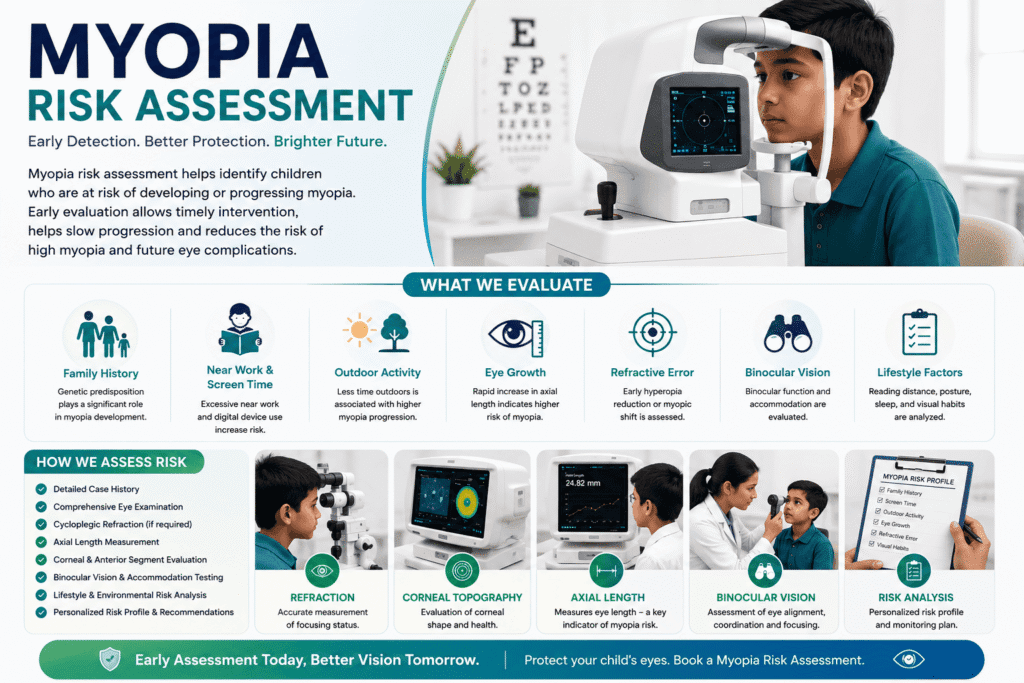
At Reform Vision Myopia Clinic we monitor myopia progression through changes in refractive error, axial length of the eye, binocular vision and response to treatment over time. Not only to enhance present vision but also to reduce long term risks to the eyes associated with progressive myopia.
The rate at which myopia progresses varies between children. Some children may show a rapid increase in spectacle power over a short period of time, while others may show a more rapid axial elongation prior to large refractive changes being evident.
The scientific evidence shows that axial elongation is one of the strongest predictors of progressive myopia and future pathological complications. Relying solely on spectacle power for monitoring may underestimate eye growth in some children. Thus, the current myopia control protocols revolve around regular axial length monitoring and refractive assessment.
Regular monitoring is helpful:
* Early detection of myopic progression
* Measure abnormal elongation of the eye’s axis
* evaluate treatment effectiveness
* Screen high-risk children
* Adapt change management plans as needed
* Reduced risk for future high myopia Components of Myopia Progression Monitoring Refractive Error Measurement
Regular refraction checks can track changes in spectacle power over time. Continued progression and need for treatment adjustment may be suggested by an increase in myopic minus spectacle number.
Occasionally, the true refractive status may be masked by accommodative fluctuations and therefore cycloplegic refraction may be needed for accurate assessment in selected children. Axial Length Measurement
One of the most important studies in evidence-based myopia control is axial length monitoring. It measures the length of the eyeball, giving an objective measurement of eye growth.
Progressive axial elongation has been demonstrated in studies to be directly correlated with the progression of myopia and the subsequent risk of retinal complications. Monitoring of axial length can often detect progression earlier than changes in refractive error alone.
Children being treated with Orthokeratology (Ortho-K) or myopia control contact lenses should be regularly monitored for:
Fitting and centring of lenses
* Corneal integrity and tear layer
* Treatment response
* Lens hygiene and compliance
Regular follow-up enhances the safety and efficacy of myopia management with contact lenses. Evaluation of Binocular Vision & Accommodation
Studies have reported that prolonged near work, accommodation reflex stress and binocular vision disorders may affect the visual symptoms and myopia development of some children. Assessment of accommodation, convergence and binocular vision may help identify associated visual factors that may need to be addressed.
Modern myopia monitoring also involves the analysis of environmental and lifestyle factors related to its progression.
Several studies from abroad have shown associations between:
More time on screens
Prolonged near work
Less activity in the outside
and increased progression of myopia in children.
Parents are therefore advised as follows:
Healthy screen-time habits
Reading distance and position
Ideas for outdoor activities
Balanced visual routines
Why follow-up matters
Importance of Regular Follow-up
• Onset age
• Rate of progression
• Axial length changes
• Current methods of treatment
• Lifestyle and visual needs
Children with rapidly progressing myopia may need more frequent monitoring to facilitate timely changes in treatment and improve long-term outcomes.
• Evidence-based myopia management protocols
• Advanced axial length monitoring
• Comprehensive pediatric eye evaluation
• Specialized Orthokeratology and contact lens care
• Individualized progression tracking
• Long-term follow-up and personalized management
• Child-friendly and technology-driven clinical environment
Reform Vision specializes in designing myopia progression monitoring to help detect early, accurately assess eye growth and personalize long-term care to reduce future complications from progressive myopia in children and young adults.