Myopia is no longer viewed as a simple refractive error corrected with glasses. Excessive elongation of the eyeball in association with progressive myopia may increase the risk of future eye diseases such as retinal detachment, myopic maculopathy, glaucoma, choroidal neovascularization and early cataract. Detailed evaluation and regular monitoring have become an important part of modern myopia management due to these long-term risks.
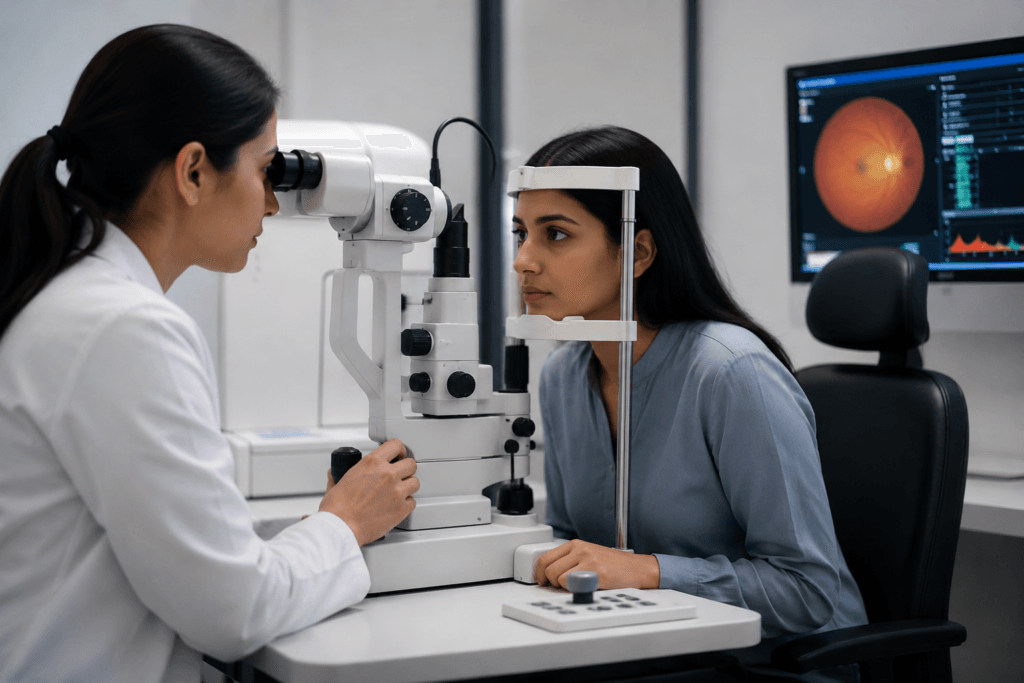
Studies in advanced myopia help in identifying children at risk of rapid progression, understanding eye growth patterns and providing evidence-based myopia control strategies. At Reform Vision Myopia Clinic , we employ modern clinical investigations for a thorough diagnostic assessment to understand the structural and functional changes associated with progressive myopia.
Routine spectacle testing alone offers less detailed information on axial eye growth, corneal shape, focusing behavior, binocular vision status and retinal health than advanced investigations. These measurements assist in developing individualized management plans based on the child’s progression pattern and visual needs.
Studies have shown that quick axial elongation is one of the best predictors of progressive myopia and future pathological complications . Changes in axial length can occur in many children before large changes in refractive power become obvious in glasses prescription. Therefore, early monitoring enables early intervention and more effective control strategies.
Children with:
often require more detailed evaluation and long-term follow-up.
More Extensive Investigations May Include Axial Length Measurement
One of the most important investigations in modern myopia management is axial length measurement. It measures the length of the eyeball, and aids in monitoring excessive eye growth associated with progressive myopia.
Studies have shown that increased axial elongation is strongly associated with future high myopia and retinal complications. The measurement of axial length provides a more accurate assessment of progression than just using changes in spectacle power.
Cycloplegic Refractions
Cycloplegic refraction means determining the true refractive error by temporarily relaxing the focusing muscles of the eye. This is especially important in children as accommodation can sometimes mask or magnify refractive findings during routine testing.
Accurate cycloplegic assessment avoids undercorrection or overestimation of myopia progression.
Corneal Topography
Corneal topography measures the shape and curvature of the cornea. This investigation is especially important before planning treatments such as Orthokeratology (Ortho-K) lenses and specialty contact lens fitting.
It also helps identify irregular corneal conditions, and provides detailed mapping of the anterior corneal surface.
Binocular Vision and Accommodation Testing
Sometimes binocular vision anomalies, accommodative stress and excessive near work demand are associated with progressive myopia. An in-depth assessment of eye coordination, focusing ability, convergence and accommodative response will help to identify associated visual problems that may contribute to visual fatigue or risk of progression.
Eye Health & Retina Evaluation
Retinal examination in myopic children especially in moderate and high myopia is important. Excessive elongation of the eye may result in increased peripheral retinal changes and a greater risk of future retinal problems. Regular retinal assessment is useful for monitoring the general ocular health and for the detection of early pathological changes as needed.
Lifestyle & environmental risk assessment
Modern myopia assessment also involves assessment of:
Several international studies have found that increased myopia progression in children is related to reduced outdoor exposure and prolonged near work.
Benefits of Advanced Myopia Research
Complete myopia tests will assist:
Advanced myopia research, long-term progression and personalized management strategies are integrated at Reform Vision to offer holistic treatment for children with progressive myopia. The aim is to not only improve vision today but also to protect long-term ocular health and reduce future complications associated with high myopia.