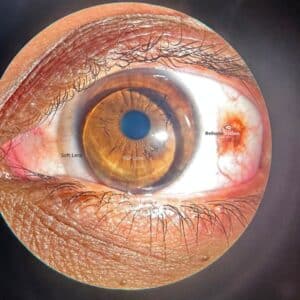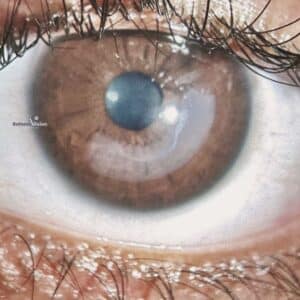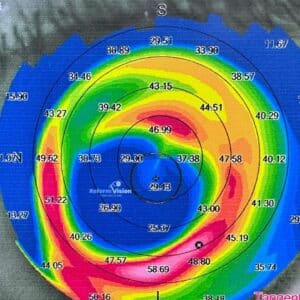
People with keratoconus often have surgery to stabilize or restore the structure of the cornea. Some of these procedures are INTACS, Corneal Collagen Cross-Linking (CXL), and Penetrating Keratoplasty (PK) or Deep Anterior Lamellar Keratoplasty (DALK). But these procedures don’t always completely fix vision, which is where scleral lenses come in.
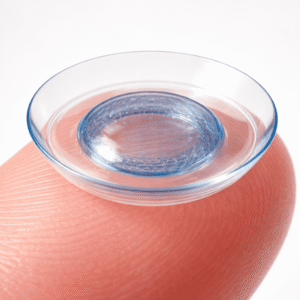
Scleral lenses are now the most important part of visual rehabilitation after surgery. Scleral lenses are a non-invasive, personalized way to either improve vision after INTACS or protect the graft after a transplant.
Why just surgeries aren't enough for vision
The main goal of surgical treatments is to stabilize the cornea or stop the disease from getting worse, not to fix uneven astigmatism or restore clear vision. Even after
INTACS: The cornea is still uneven, so regular lenses might not fit well.
CXL: Progress slows down, but the clarity of vision doesn’t get better on its own.
Corneal Transplants: After surgery, astigmatism is often high and hard to predict.
This makes a lot of people go back to contact lenses. Scleral lenses are the best choice for most post-surgical corneas in 2025.
Scleral Lenses After INTACS ▹ What are INTACS?
INTACS are semicircular implants that are put into the cornea to flatten its cone and make it less distorted.
🔹 Problems after INTACS: The cornea is still not symmetrical.
More sensitive corneas
Hard lenses can come loose or rub against implants.
Glasses still don’t fix astigmatism that isn’t regular.
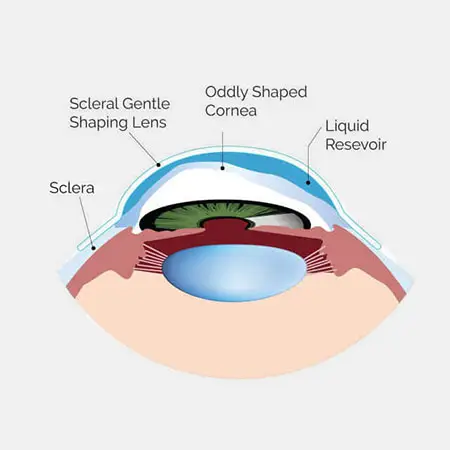
🔹 How Scleral Lenses Help: They let you vault over the INTACS ring without touching it.
Give a smooth, even optical surface.
Make vision and comfort much better.
Get rid of halos and glare.
After INTACS, patients often get vision of 20/25 or better with the right design of scleral lens.
Scleral Lenses After CXL (Corneal Collagen Cross-Linking) What is CXL? CXL uses UV light and riboflavin drops to make the cornea stronger, which helps stop keratoconus from getting worse.
🔹 Things to think about after CXL
Vision may still be blurry because of the shape being uneven.
It may be hard to wear old lenses because the cornea’s shape has changed.
The healing of the corneal surface is different, so gentle lens options are needed.
🔹 What Scleral Lenses Do
After stabilization, which usually happens 3 to 6 months after CXL, refit the cornea.
Give better hydration and centering.
Don’t touch healing corneal tissue with anything mechanical.
Can put off or get rid of the need for more surgery
After CXL, a lot of patients find that they can wear scleral lenses for longer periods of time and that their lenses are more comfortable.
Scleral Lenses After a Corneal Transplant (PK or DALK): Why Do People Get Transplants?
Corneal transplants (full-thickness or partial) are the last resort for restoring structural integrity in cases of very advanced keratoconus or scarring.
🔹 Problems After Transplant
High irregular astigmatism
Changes to the surface caused by sutures
Long periods of healing (months to years)
Glasses can only fix a little bit of vision.
Graft-host junction makes RGPs intolerable.
How Scleral Lenses Help with Healing and Seeing
Vault all the way over the graft and host tissue to avoid mechanical friction.
Make the optical surface smooth so you can see clearly.
Spread the weight of the lens over the sclera to lower the pressure on the graft.
Can be worn comfortably for 8 to 14 hours a day.
Some research shows that they may help lessen post-PK haze and epithelial breakdown.
Scleral lenses are a way to fix problems with the eyes and vision after a graft without having to have surgery.
Benefits of Scleral Lenses After Surgery:
✅ Custom vaulting over corneas that are uneven or sensitive
✅ Better visual acuity and contrast sensitivity
✅ High oxygen transmission (in newer designs)
✅ Therapeutic hydration and protection for the surface of the eye
✅ Longer wear time with little discomfort
✅ Protection from wind, dust, and other irritants in the environment
A Patient's Journey: From INTACS to Clarity
A 28-year-old man who had INTACS surgery still had trouble seeing clearly and seeing ghosts. He got a new mini-scleral lens that was made with AS-OCT to make sure that it completely covered the implants. He went from 20/80 (with glasses) to 20/25, and he wore them for 12 hours a day with no pain.
What Patients Need to Know
You can still wear scleral lenses years after surgery.
Most patients get their functional vision back with few side effects.
Advanced imaging (OCT, topography) makes it easier to fit lenses correctly.
To keep the cornea and ocular surface healthy for a long time, regular follow-up is very important.
End
INTACS, CXL, and corneal transplants are examples of surgical treatments that deal with the structural progression of keratoconus. However, they do not fix visual distortion. Scleral lenses are the link between surgery and seeing clearly and comfortably. In 2025, scleral lenses are a safe, reliable, and highly customizable way to help people with vision problems after INTACS, CXL, or a transplant.
The Author
Reekham Lal works at Reform Vision Hyderabad as a keratoconus and scleral lens expert. He has been in charge of post-surgical corneas for more than ten years and offers custom scleral lens solutions for eyes that are hard to fit or have irregular shapes.